DESTINATIONS
Kyrgyzstan: Riding the Silk Road at the Edge of the World
Words by Roxanne Lautenbach
Photos by Alex du Toit
Kol-Suu Lake sits deep in the Al-Bashy region of southern Kyrgyzstan, at roughly 3,500 metres above sea level. Formed by an ancient earthquake and known in summer for its startling turquoise waters, Kol-Suu Lake in Kyrgyzstan draws hikers and overlanders during the warmer months.
We went in winter.
Not because it was sensible. Not because it was convenient. But because if you’re going to travel to the edge of the map, you may as well see it stripped bare.
Leaving the Known World
The moment we turned toward the Chinese border, it felt as though we were driving off the edge of something known. The roads thinned. The buildings disappeared. Infrastructure dissolved into white silence. Only the occasional freight truck reminded us that trade still moved through this corridor, that the world had not entirely stopped.
And then there was nothing.
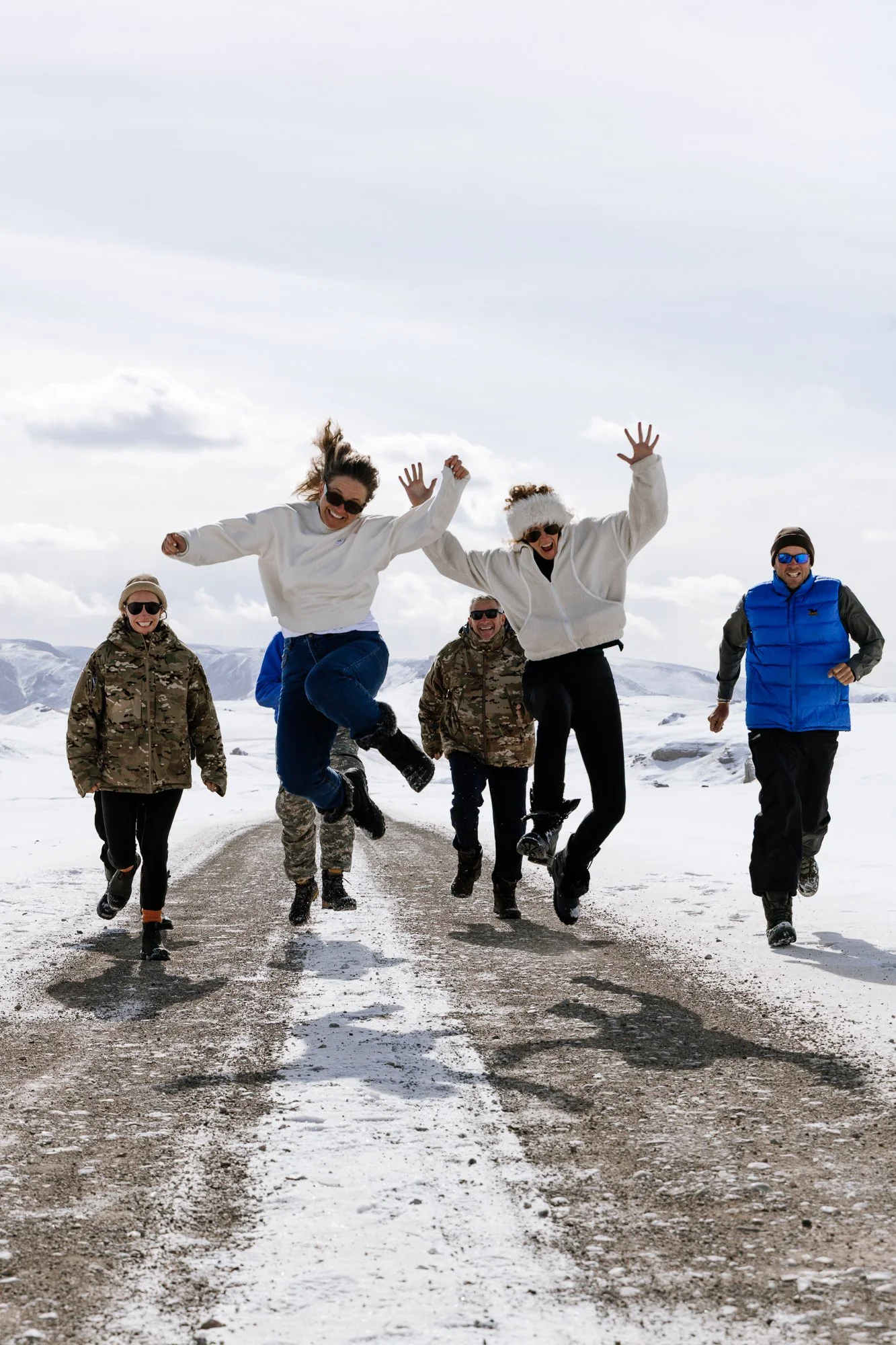
Just one road, snow-covered, barely distinguishable from the land beside it, and a vastness so bright beneath the winter sun that it felt like a desert made of light. The only reminder that this was not some surreal mirage was the sharp -16°C pressing insistently against our skin when we got out to stretch our legs and have a ‘pinch me’ moment with our crew in the second vehicle.
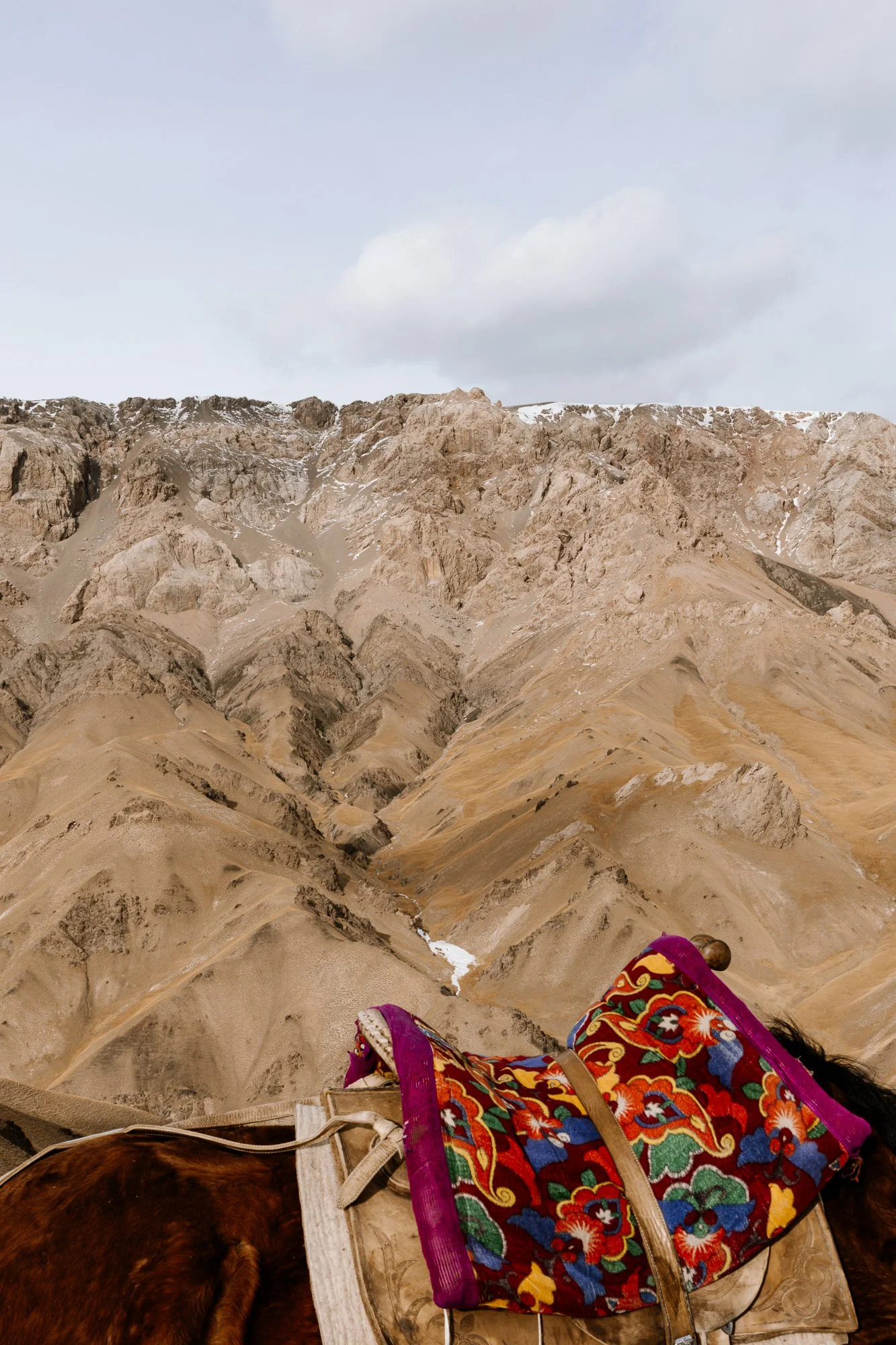
The Tien Shan mountains rose like sleeping giants on either side of us, their ridgelines softened by fresh snow, their shadows long and blue. The silence here is not absence; it is presence. It hums.
By the time we reached base camp - our hanger, a couple of yurts, and some livestock pens - the warmth felt earned. Tea appeared without request. Our host, Meder, greeted us with that understated hospitality that feels typical of rural Kyrgyzstan: minimal fuss, maximum generosity.
We had come for horse trekking in Kyrgyzstan in the depths of winter. Which meant there was very little lingering, and after lunch we were off…
Where the Road Stops
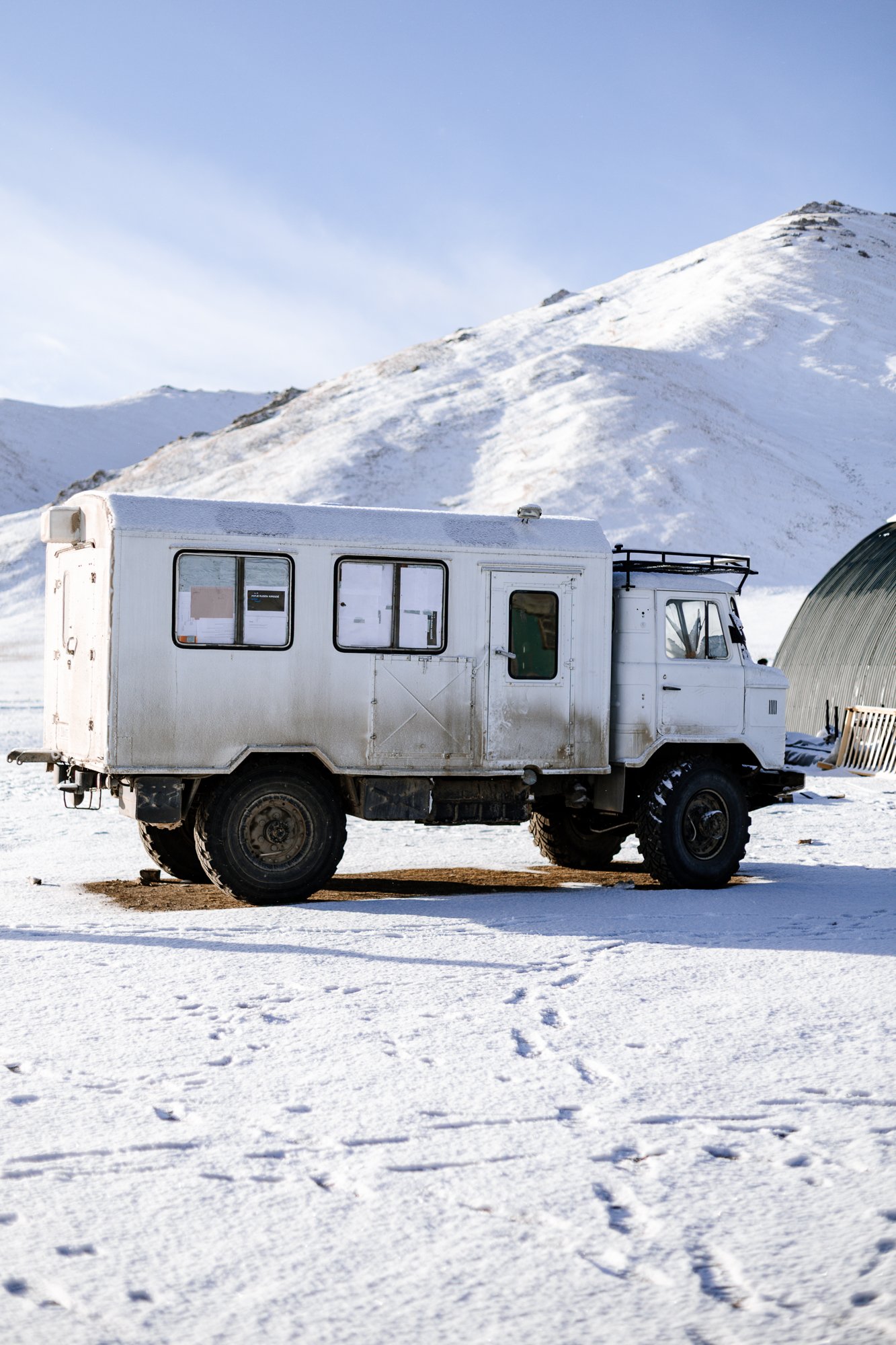
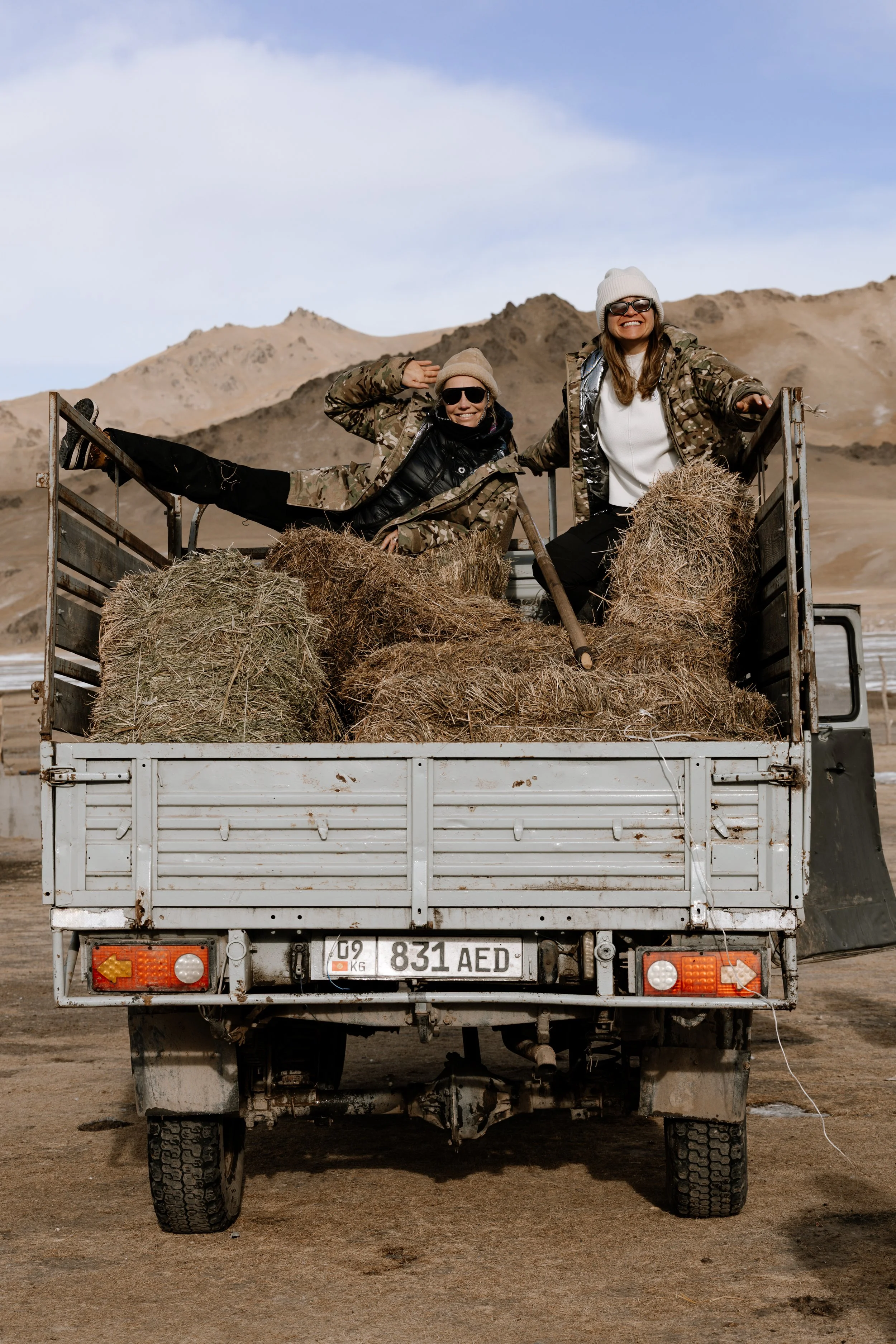
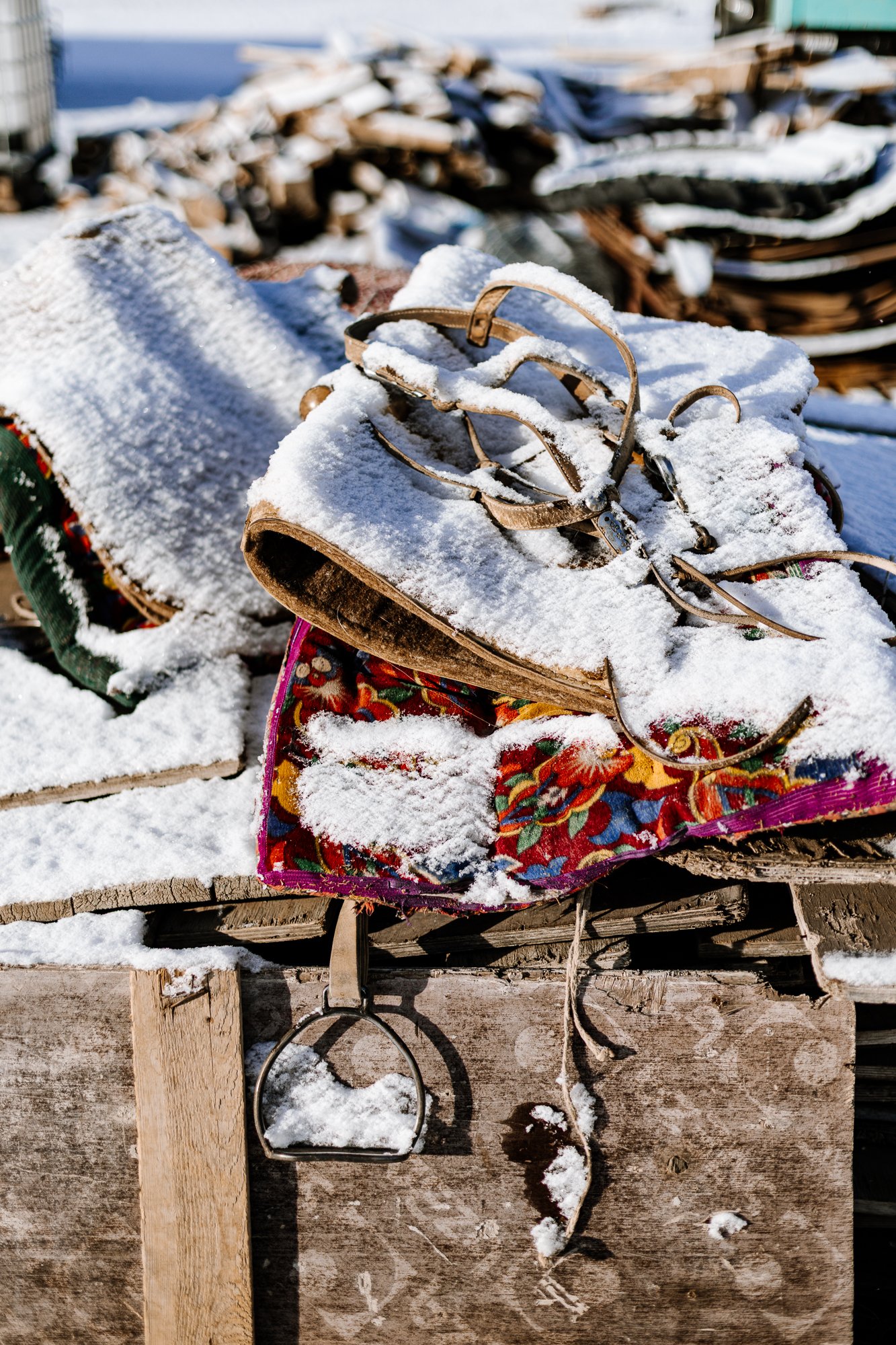
We climbed into the back of an old Soviet truck and headed further into the mountains to feed the ponies.
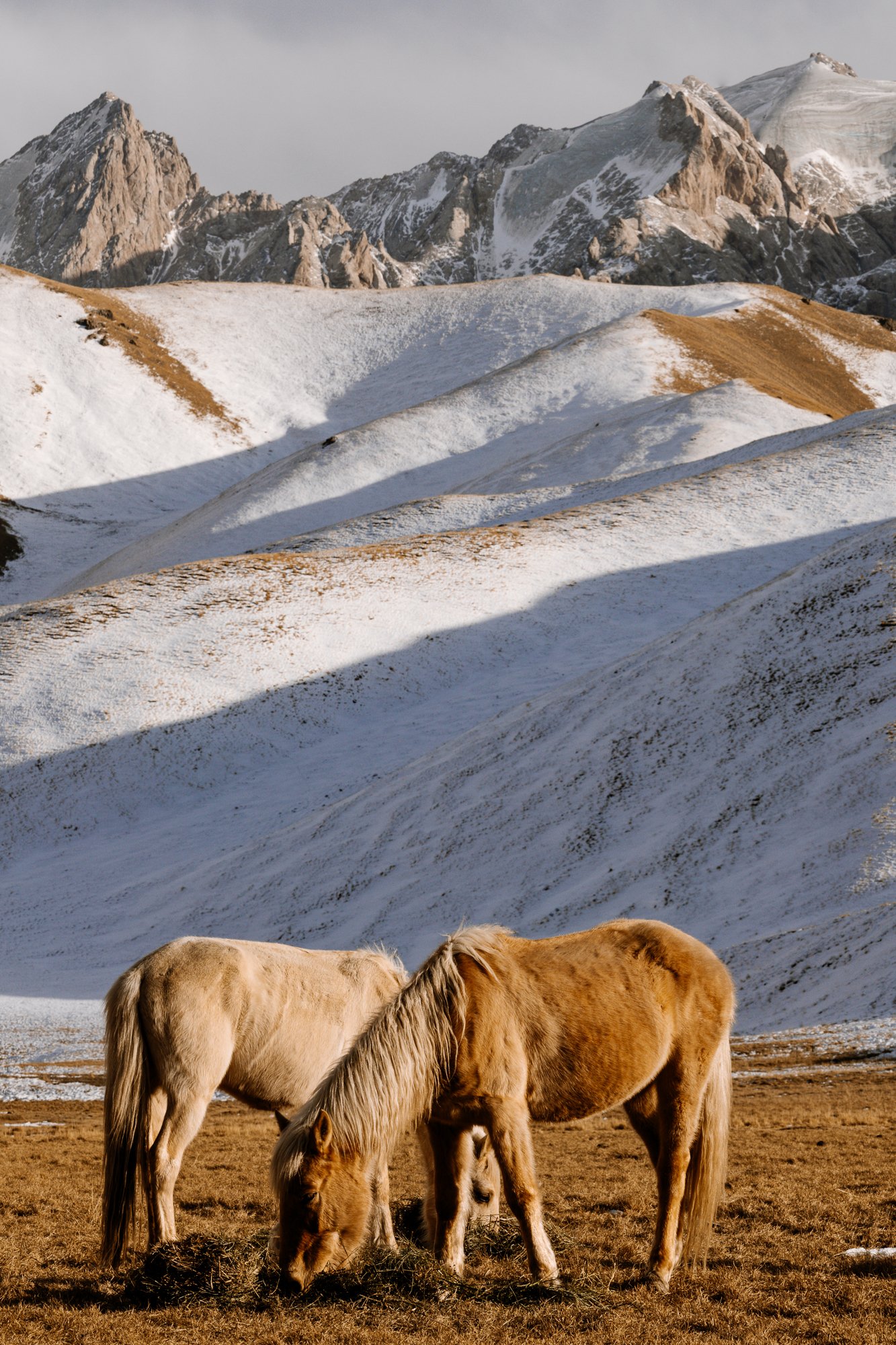
Perched on hay bales, we attempted to shield ourselves from the windchill that nipped at our noses and crept down our collars. But distraction came easily. Every corner revealed another mountain peak, white and infinite, while the pastures below remained a muted winter gold, like brushed velvet under frost.
And then the road ended.
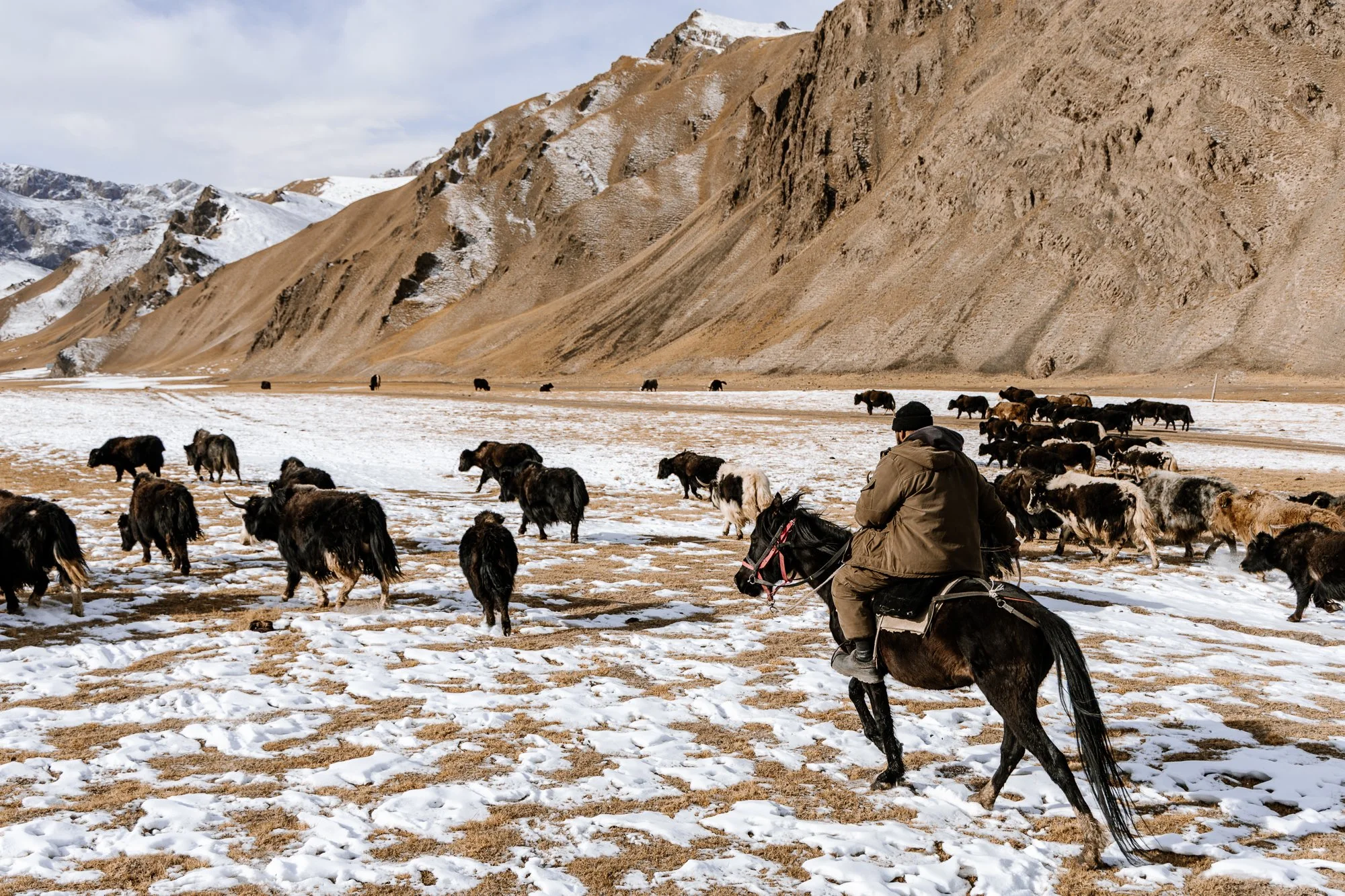
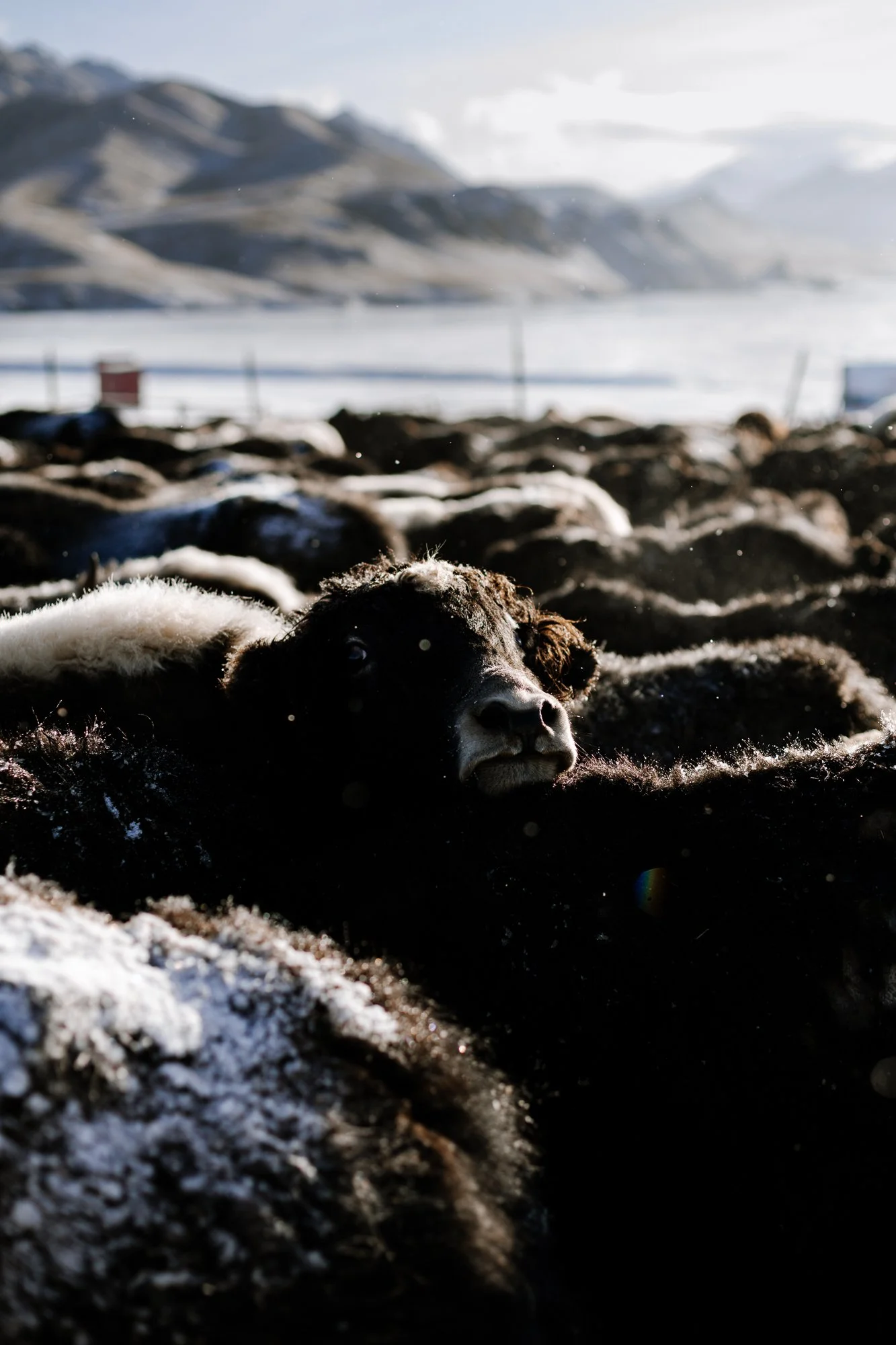
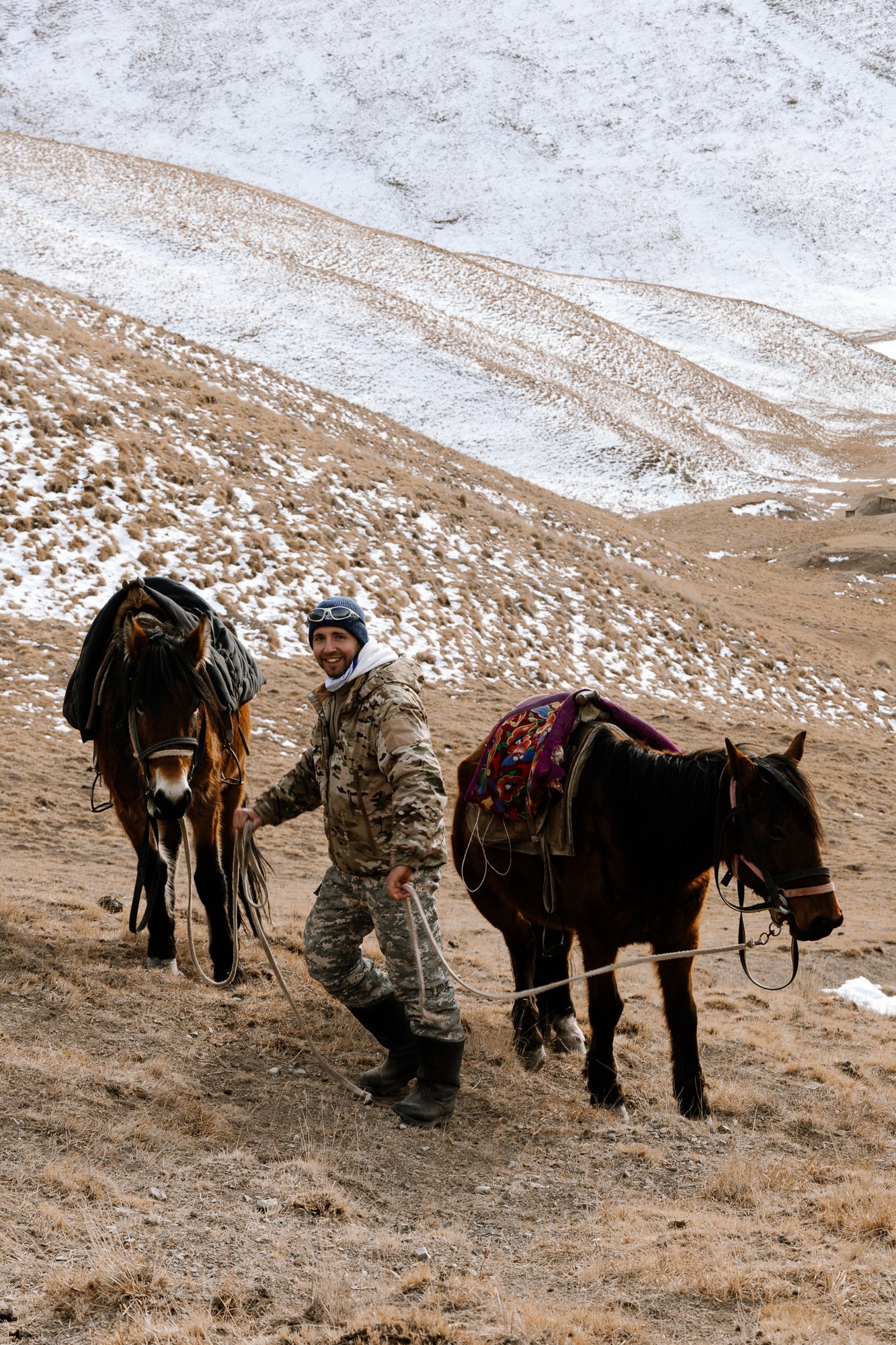
No dramatic marker. No sign. Just a shepherd waiting with his horses and a loose congregation of yaks scattered high along the slopes.
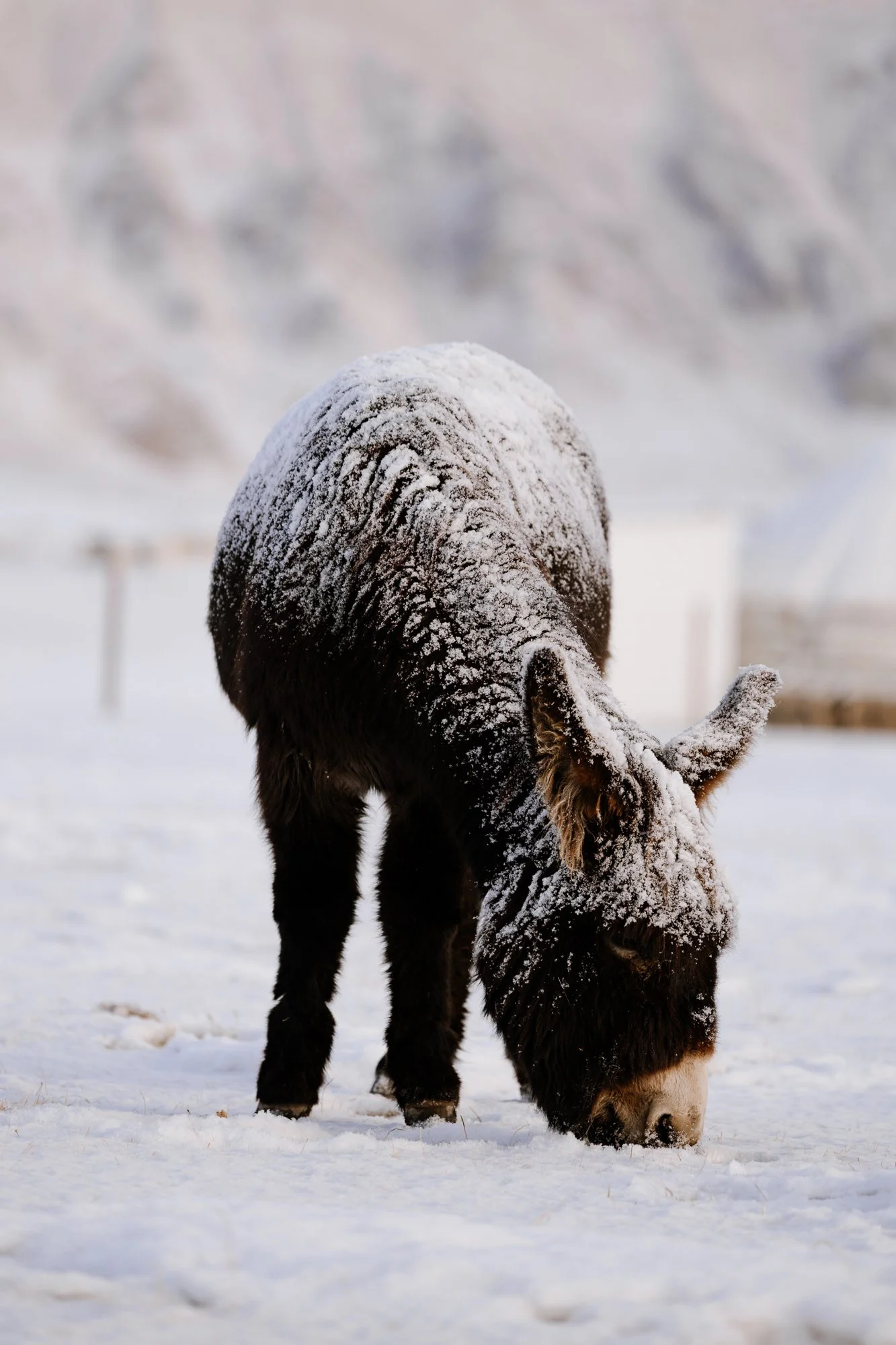
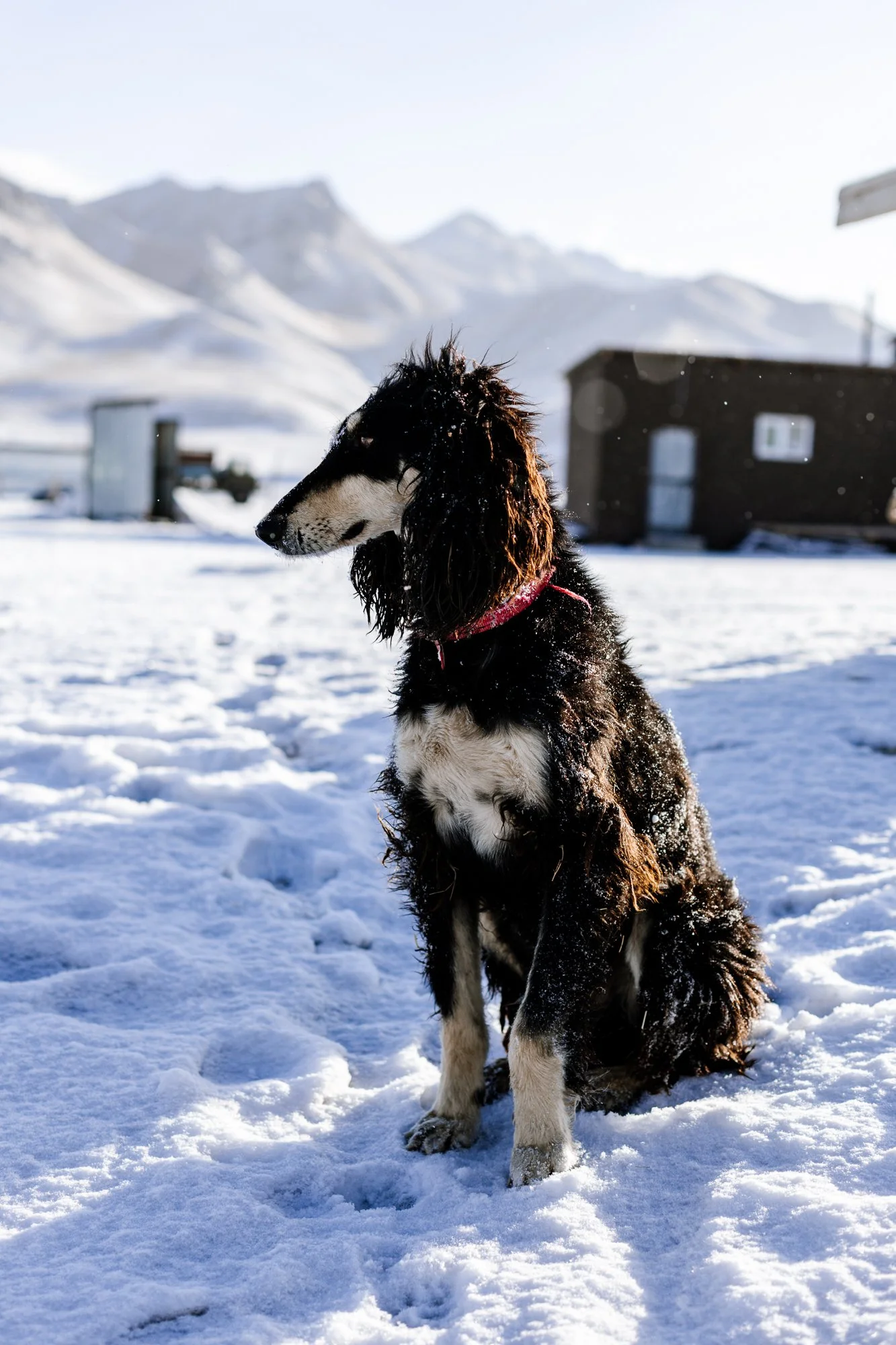
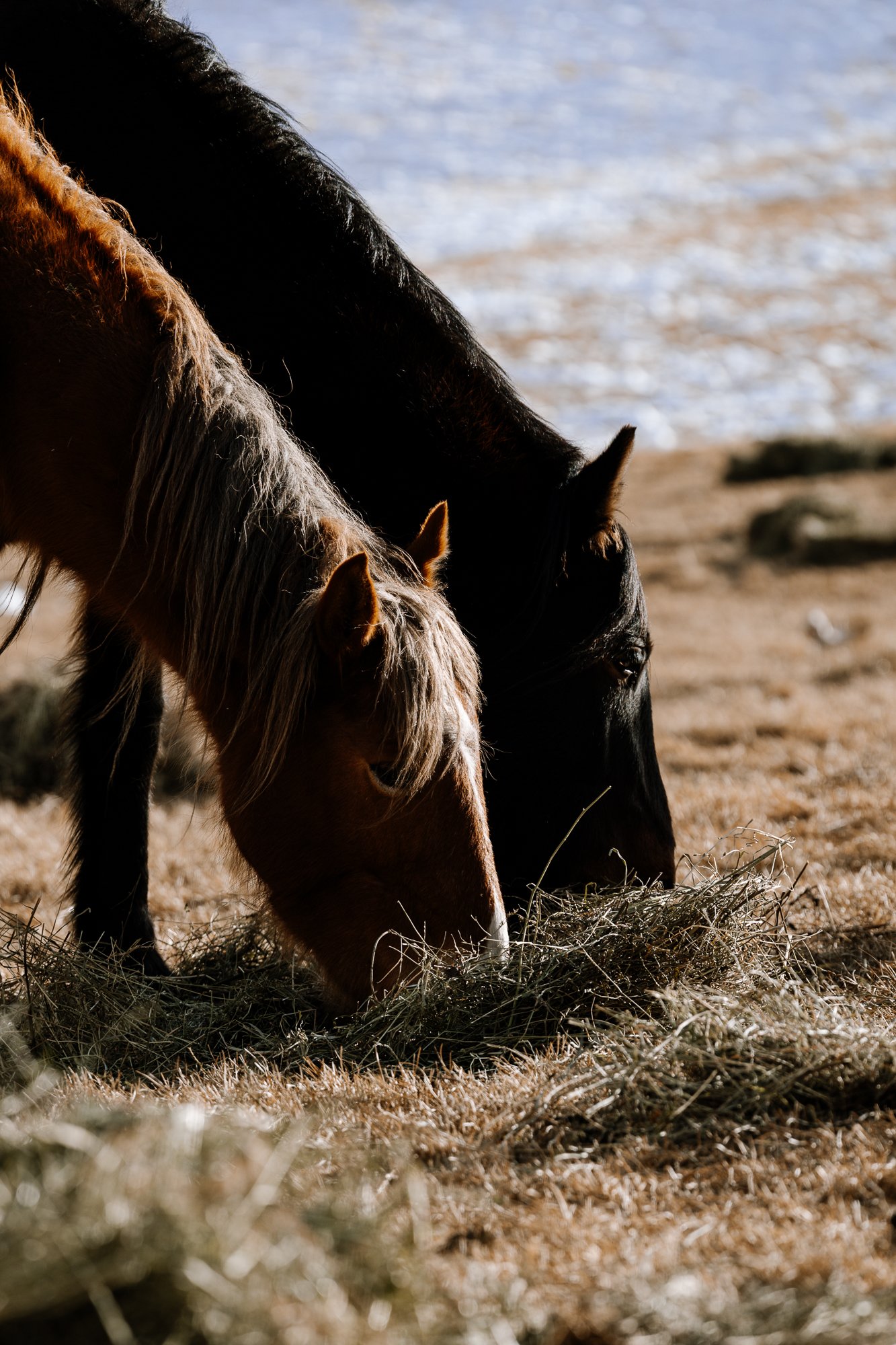
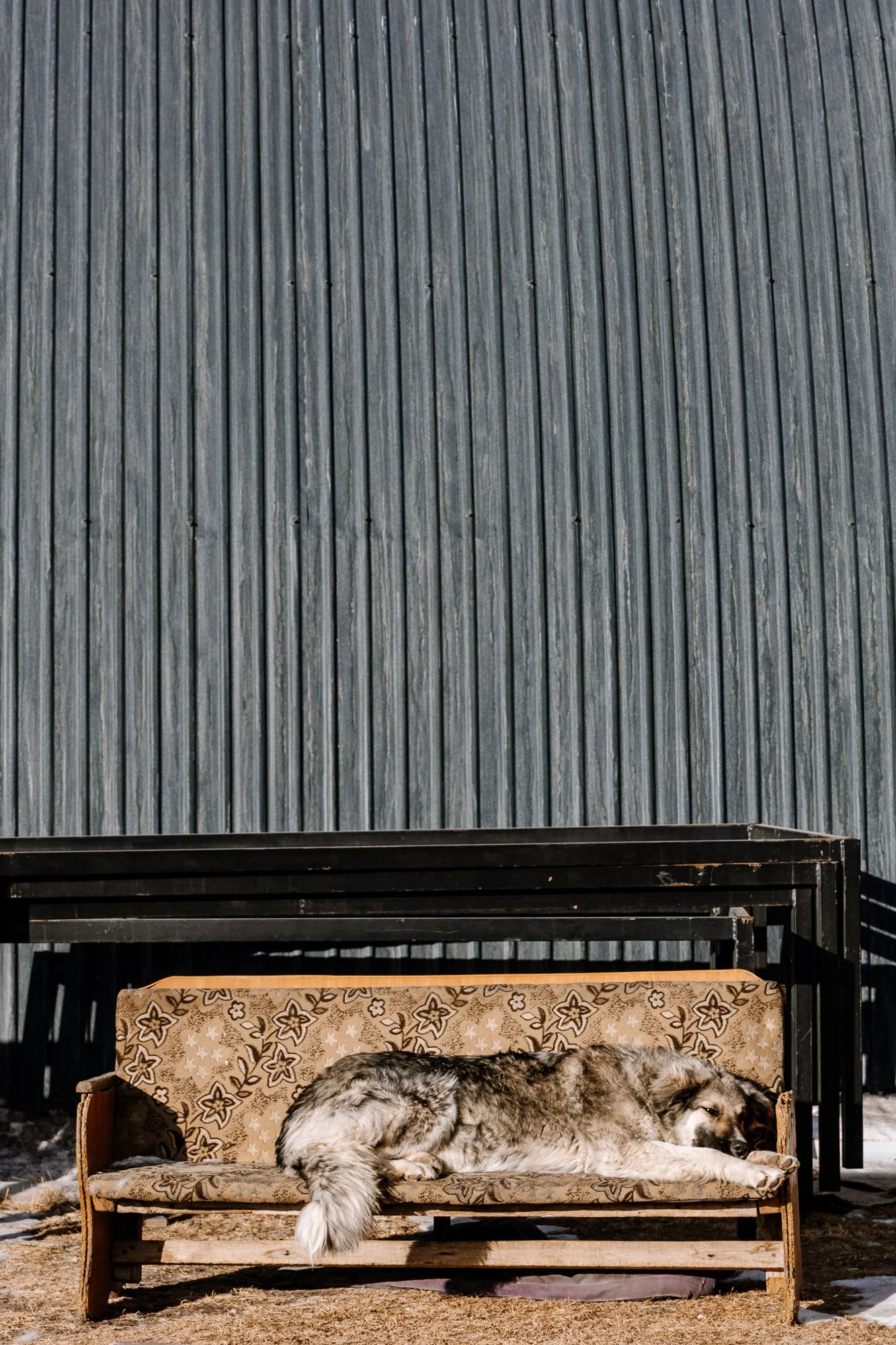
Meder called out, a sound that carried across the valley, and the herd lifted their heads in unison before trotting toward us. Hay was offloaded, broken apart, scattered across the snow. For a brief moment, there was frenzy: hooves, steam, dogs weaving through legs. Then, like a tide receding, everyone found their place. Horses chewed. Dogs curled into themselves. Conversations softened
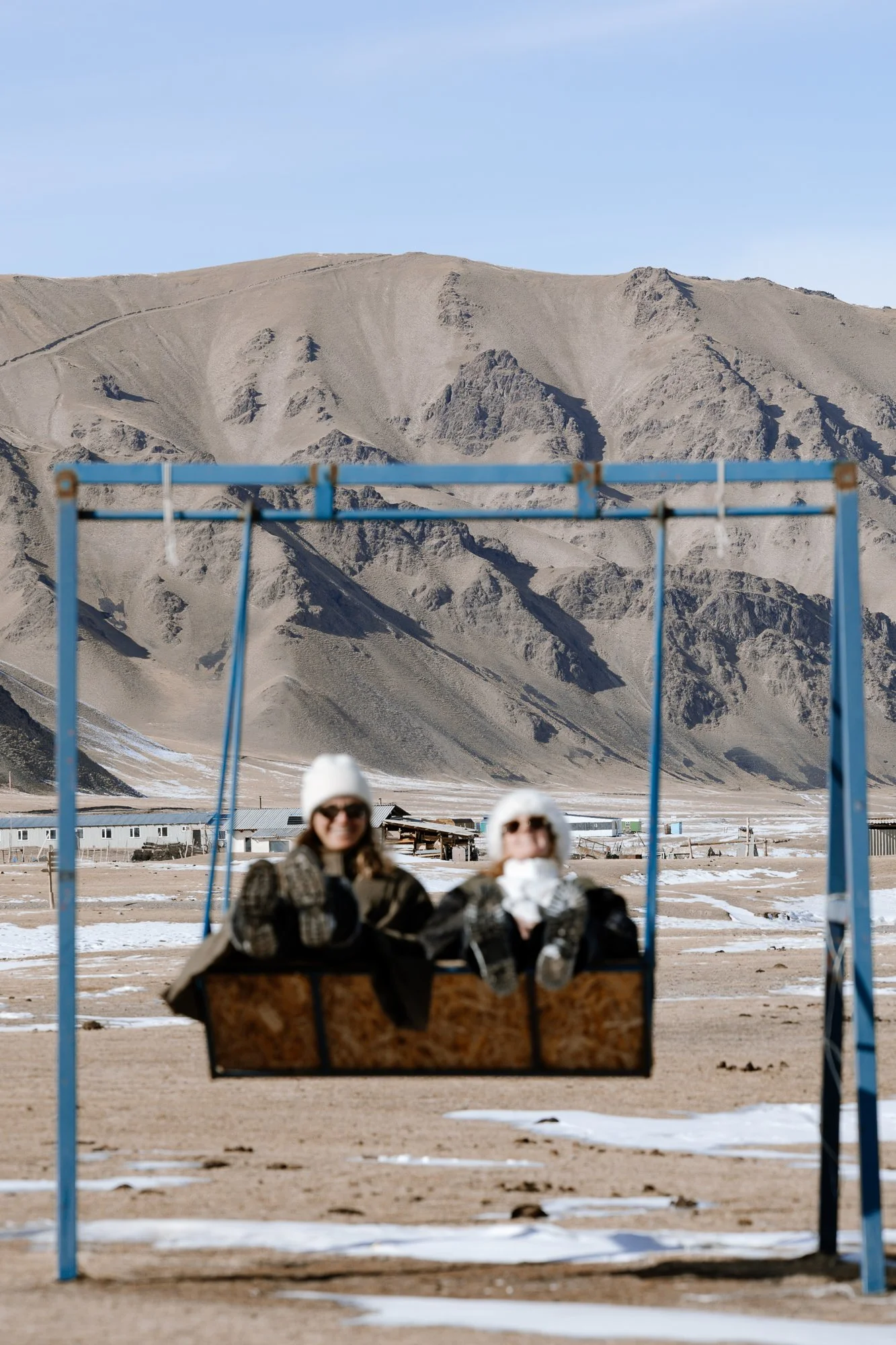
It struck me then how quickly perspective shifts in places like this. Two years ago, Kyrgyzstan wasn’t even on my mental map. Two years ago, most of the people sitting beside me weren’t in my life. And yet here we were, in sub-zero temperatures, rosy noses, and entirely content.
Riding holidays have a way of compressing time. Shared discomfort accelerates connection. When you’re navigating frozen streams and herding livestock together, there’s no small talk. You see how someone handles uncertainty. You see who laughs first when things go slightly wrong.
Out there, nothing is curated. The cold doesn’t care about your aesthetic. The horses certainly don’t.
And that’s precisely why it works.
Riding With the Shepherds
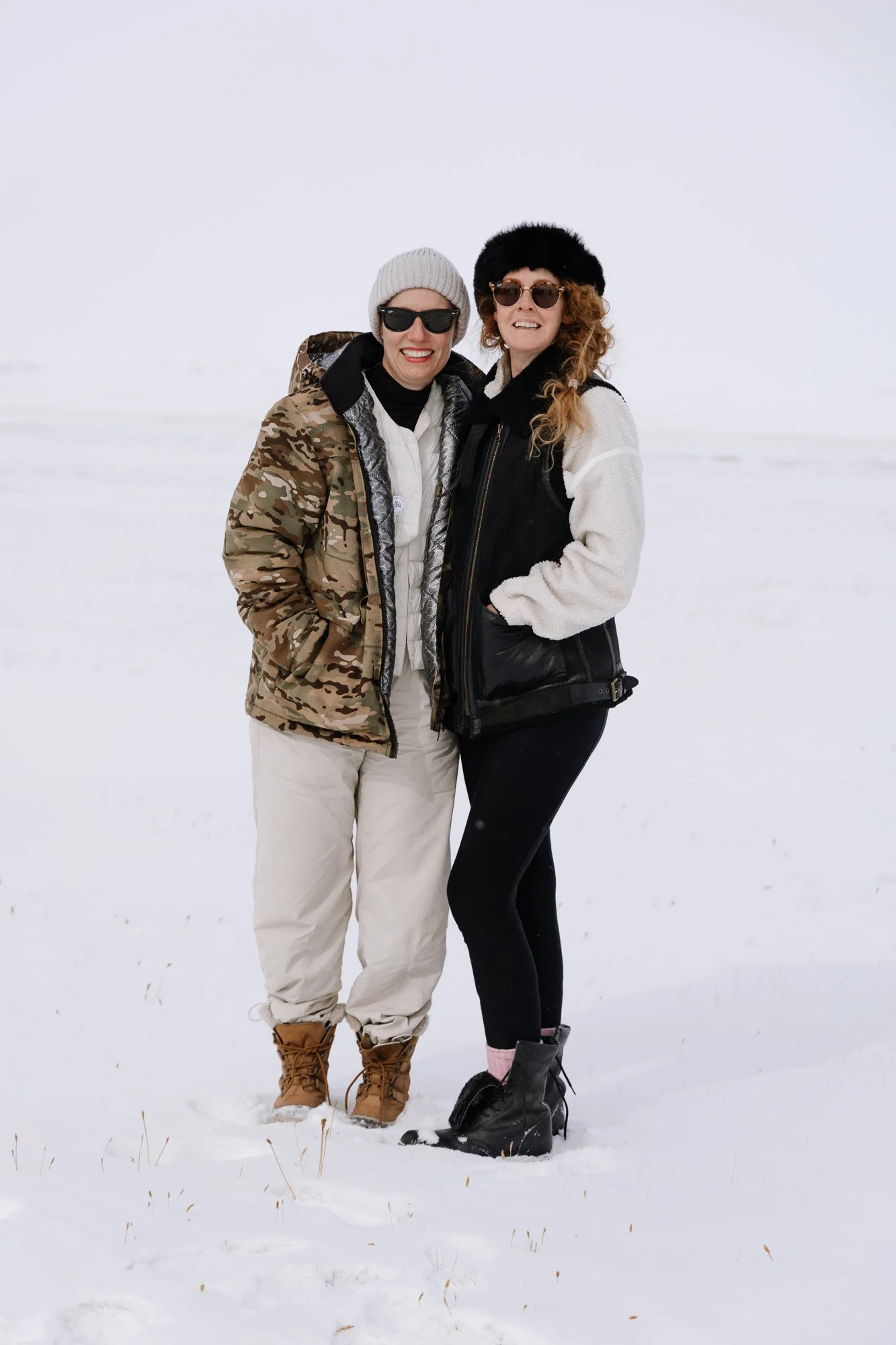
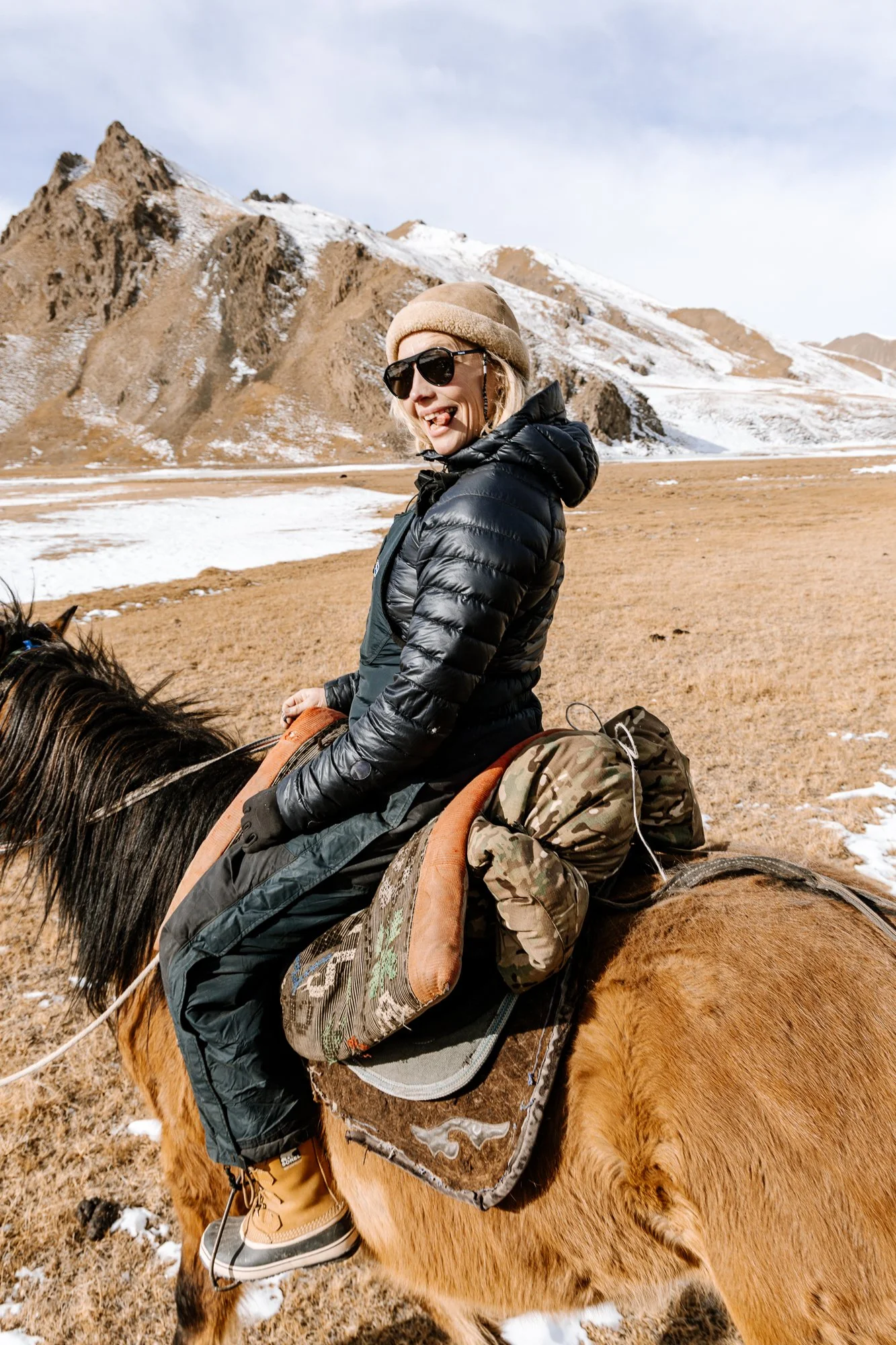
The next morning, double thermals and borrowed Chinese army jackets in place, we saddled up.
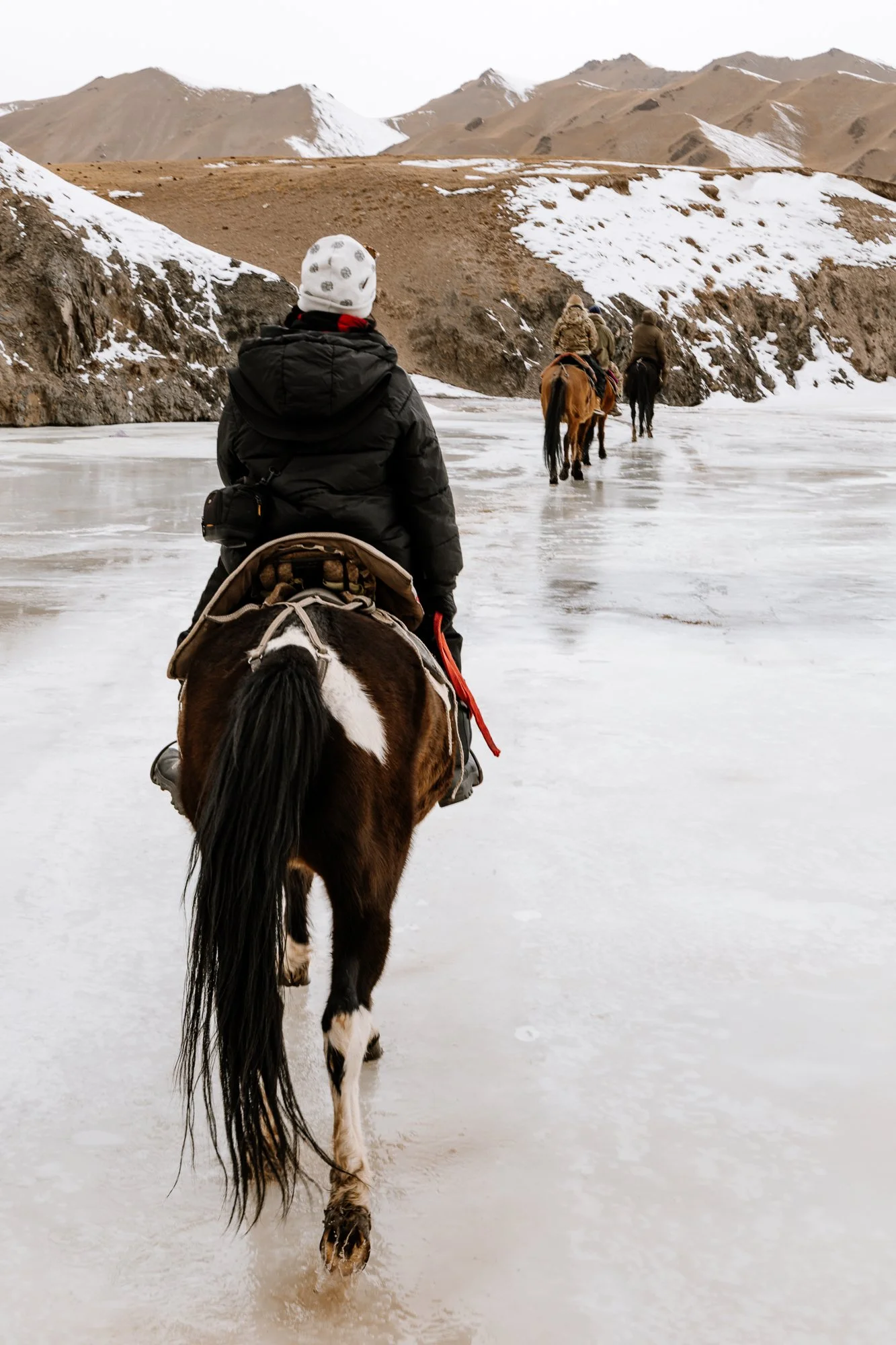
As a child of Africa, I’ve only seen snow a handful of times and never from horseback. The first obstacle was a frozen stream. Without hesitation, the ponies stepped forward, tapping deliberately at the ice until it cracked. Water surfaced. Ice gave way. They crossed as if this were the most ordinary thing in the world.
Ice-skating on horseback had not been on the 2026 bingo card, but here we were, trusting animals who knew this land better than any of us ever could.
Riding in Kyrgyzstan is functional. It is not about heels down or perfect posture. It is about movement with purpose: finding your herd, crossing valleys, covering distance efficiently. The nomadic shepherds of Kyrgyzstan ride because life here requires it.
That day, we rode alongside them on what was once part of the original Silk Road.
It is difficult to fully comprehend that you are cantering through valleys that once carried caravans of silk, spices, and stories between East and West. That centuries ago, traders moved through these same corridors. That Genghis Khan himself is believed to have crossed landscapes like this during the expansion of the Mongol Empire.
There are no plaques announcing this. No dramatic re-enactments. Just wind. Just snow. Just the weight of history embedded in the land.
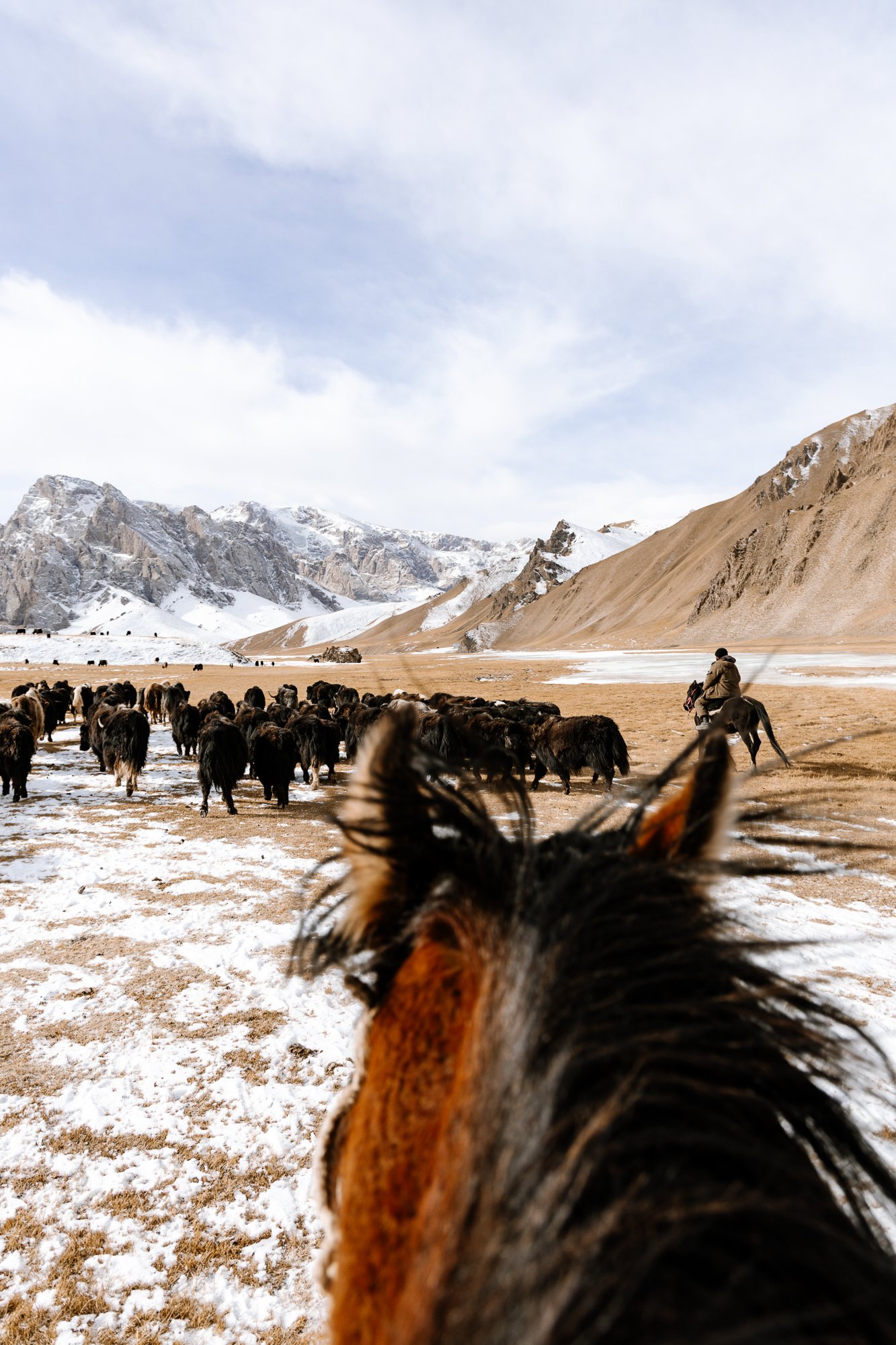
We rallied nearly 100 yaks up the valley toward Kol-Suu Lake, urging our ponies forward with an enthusiastic “chu-chu” until they slipped into a steady canter. Hooves struck frozen ground in rhythm. The yaks moved as a dark tide against the golden pastures.
We then began our climb towards the lake. We rode into the mountains rather than across them, winding upwards towards ridgelines that looked as though they had been sketched in charcoal and dusted with snow. The ponies never hesitated. Ice, loose rock, frozen mud, slivers of track no wider than a boot sole. They adjusted without drama, placing each hoof with quiet precision. While we leaned forward instinctively, they moved with the calm assurance of animals who belong here. Trusting them wasn’t optional; it was immediate.
Kol-Suu, Frozen Solid
In summer, Kol-Suu Lake in Kyrgyzstan is famous for its turquoise brilliance. In winter, it becomes something else entirely. The water was locked beneath a sheet of ice, its surface fractured and opaque.
It looked unreal. Like a puzzle box scene assembled too perfectly to be accidental.
We had made it out of the group chat. Out of hypothetical conversations and pinned Instagram locations. We were here, riding the Silk Road, breathless in more ways than one.
There was no postcard perfection about it. It felt raw. Architectural. Uncompromising.
We didn’t cheer when we arrived. We didn’t rush for photos. We just stood there, appropriately small, at 3,500 metres above sea level, breathing thin air and taking it in.
This is what travel to Kol-Suu in winter gives you: not spectacle, but scale.
Evenings at the Edge
That night, warmth returned in the form of fresh socks, good conversation, and whisky.
Another group had arrived (visiting the lake by car rather than horseback) and for the first time on the trip we were reminded that we were not entirely alone in this region. Our guide, Mati, has curated something deliberately remote. Until then, our experience had been anchored in family homes and local hospitality. A true Kyrgyz experience staying in old soviet towns not visited by many Westerners. Not for everyone, but just the way we like it.
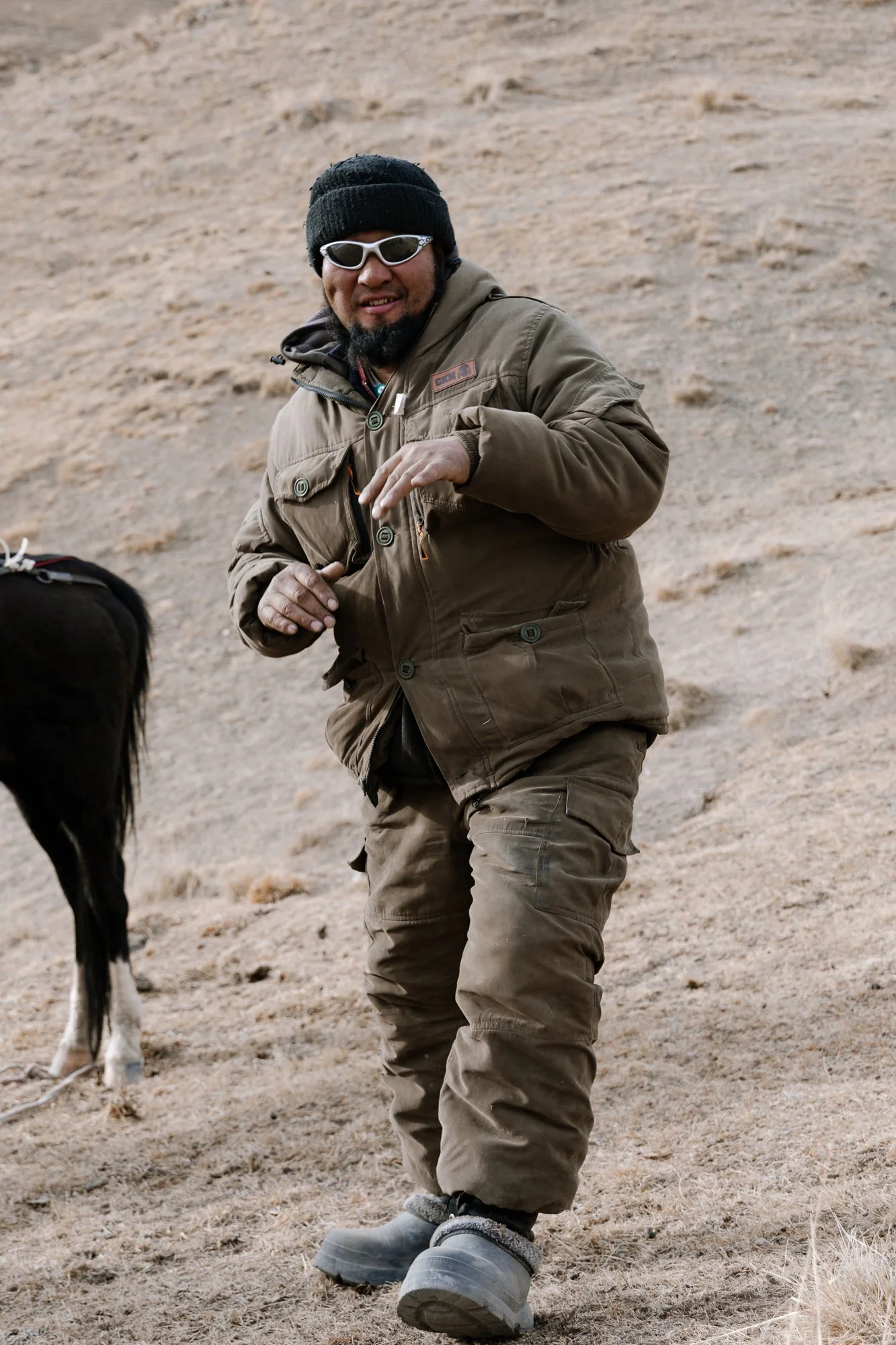
The speaker came out. The volume went up. And what followed was less “cultural exchange” and more joyful chaos. The Kyrgyz national dance was demonstrated first. Precise hands, proud posture, feet that seemed to skim the floor. We tried. Respectfully at first. Then enthusiastically. Then competitively.
The Polish steps arrived next, full of bounce and spin, and before long South Africa entered the chat. Rhythm heavier, hips looser, absolutely zero concern for altitude-induced breathlessness, as we spun ourselves around. Boots thumped, arms flailed, and the kind of laughter that warms you faster than the stove ever could, filled our yurts.
The Morning Everything Turned White
On our final morning, we woke to a different world.
Fresh snow had fallen overnight, thick, luminous, untracked. It’s not common for the valley to receive that kind of blanket, and it felt like Kol-Suu had quietly rearranged itself for our departure.
Edges softened. Tracks disappeared. Fences and rocks dissolved into white.
The drive out felt almost disorientating. The horizon blurred. The sky merged with the land in places. It no longer felt like Central Asia. It felt like Antarctica. Vast, exposed, almost abstract in its simplicity.
There is something about a landscape rendered entirely white that demands quiet, and it was during that drive that we spotted them.
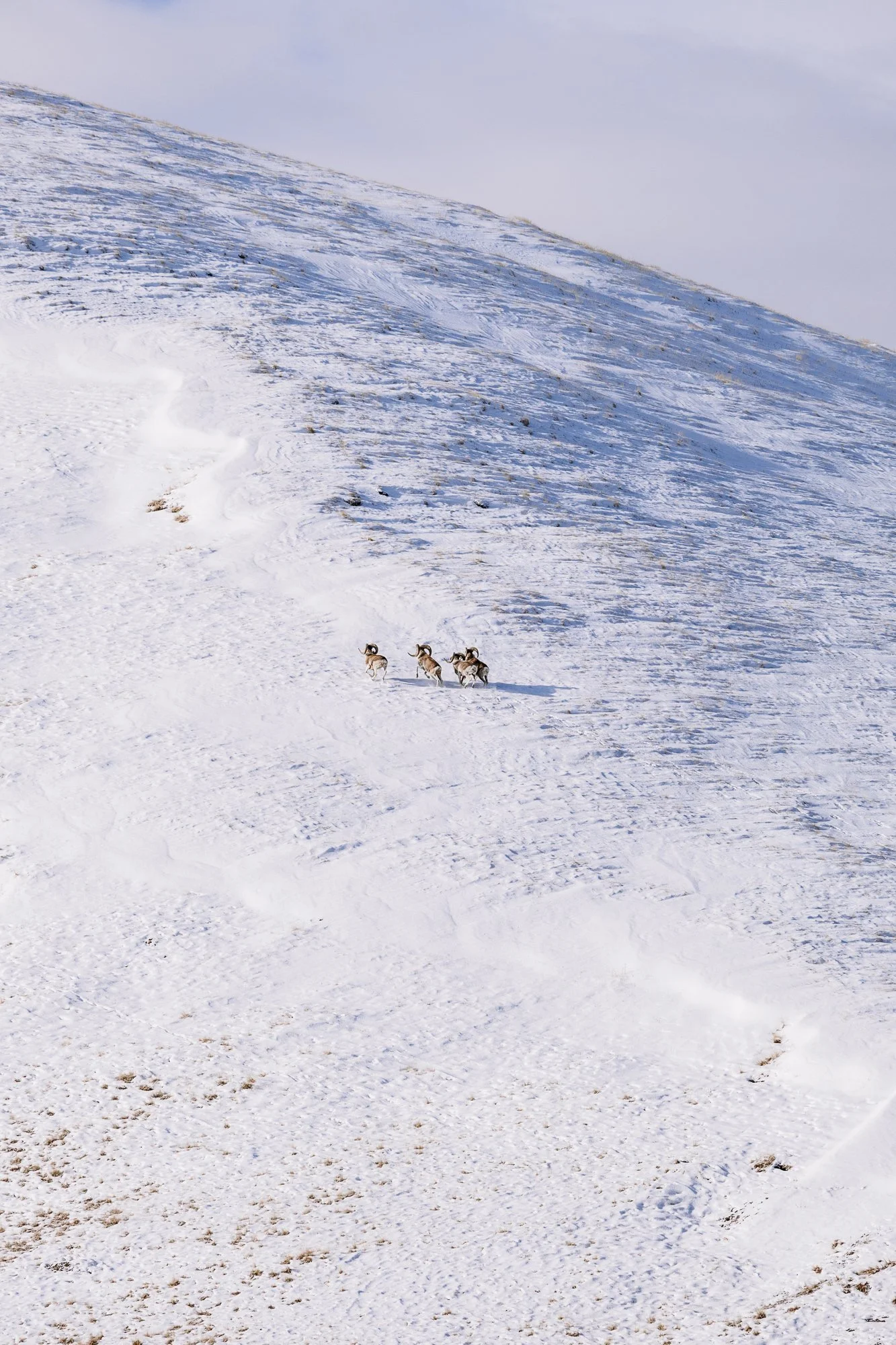
Ibex.
Not close enough for detail. Not cinematic. Just dark shapes moving high along the mountainside. You had to look properly to register them. To separate movement from shadow.
And maybe that’s what made it so special.
My late brother was a game ranger. He taught me, long before I understood the weight of it, that wild animals are not spectacles; they are privileges. That to witness them in their natural habitat is to be briefly let in on something sacred.
Standing there in the snow, watching the ibex navigate terrain that would humble any human, I felt that familiar tightening in my chest. Not dramatic. Not overwhelming. Just recognition. A reminder that the world is still full of beauty, still capable of surprising us, still generous enough to offer moments that feel almost too perfect.
Kol-Suu in winter does not perform for visitors. The cold is real. The altitude is unforgiving. The comforts are simple. Roads disappear. Plans shift. You earn every view.
And that is exactly why it is worth going.
In the quieter months, without the summer traffic and turquoise postcards, you see something closer to real life up here. Shepherds moving herds because that is what the season demands. Horses work because that is what they were bred to do. The beauty is not polished, it is lived in.
If you are willing to ride with shepherds along the old Silk Road, to trust mountain ponies across frozen streams, to climb into mountains that look almost imagined, and to sit in silence when the landscape turns entirely white, Kol-Suu gives you access to something rarer than spectacle.
It gives you perspective.
It gives you scale.
It gives you quiet beauty in the land, and in the people who call it home.
Not loudly.
But undeniably.